

5 essential components of a GDP-compliant QMS that is actually useful
A compliant quality management system is mandatory for marketing authorisation holders (MAH) or wholesale distributors of medicine in the EU. But more importantly, it is a useful management tool. In this article, you can learn more about the five core elements of establishing and maintaining a GDP-compliant QMS.
The EU’s Good Distribution Practice (GDP) guidelines set extensive documentation requirements for pharmaceutical quality management systems (QMS), and many smaller distributors struggle to establish and maintain a compliant QMS. Even more struggle to make the system a useful management tool in day-to-day operations.
An outdated or poorly embedded QMS is not just a GDP compliance issue. It is a business risk and, at worst, a patient safety liability.
The resources to create and uphold a compliant system are well spent for several reasons: Not only does a good QMS help to ensure patient safety. Correct processes for the distribution of medicine also reduce the risk of mistakes and ensure that you are compliant and inspection-ready. Moreover, it is a useful tool to evaluate and align your quality compliance efforts with your business strategy.
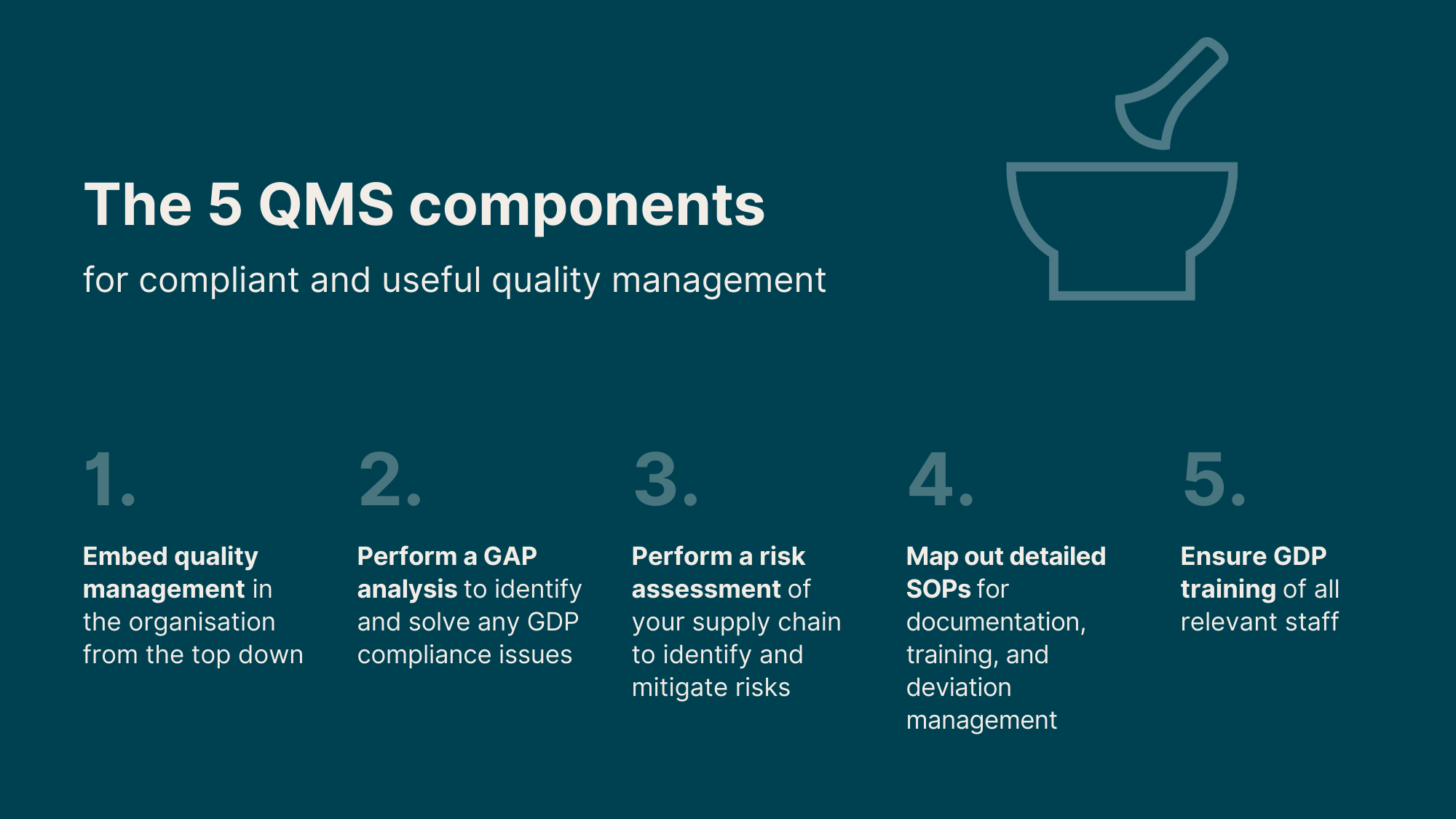
At PharmAdvice, we take a structured approach to pharmaceutical quality management. To ensure that our client’s QMS is aligned with their specific regulatory requirements and objectives, including GDP guidelines and local regulation, we base each QMS on the following five components:
1: Organisational embedding from the top down
If GDP compliance is to be more than a mere paper exercise, the system must be deeply embedded in the organisation, starting with the management.
A quality policy based on the GDP guidelines may frame the overall scope and objectives of the QMS and ensure alignment of the organisation’s quality efforts and the QMS SOPs. Continuous training may help anchor the quality management throughout the organisation.
But the compliance measures must be underpinned by managerial focus and commitment and a genuine understanding of the legislation for the QMS to become a useful tool for strategic quality management.
2: GAP analysis
The gap analysis identifies where your current distribution practices do not meet GDP requirements. Establishing a clear overview of distribution issues minimises the risk of authority findings and enables fast action on critical gaps.
3: Risk assessment
The risk assessment identifies potential risks in your supply chain. Knowing the risks enables you to mitigate them and reduce their likelihood. The risk assessment is revisited whenever legislation, equipment, suppliers etc. change.
4: Standard operating procedures
Detailed SOPs for all vital processes, including change control management and deviation handling and CAPA management (Corrective and Preventive Actions), are essential to ensuring consistent operations and systematic, ongoing documentation of your distribution practices. They help minimise errors, guarantee traceability and make it easier to onboard new staff.
5: GDP training programs
Setting up training programs and procedures to monitor and document all GDP training ensures that all relevant members of staff are on track with current legislation and company processes. Yearly monitoring and planning are decided through management reviews.
Need help establishing and implementing a compliant QMS?
Our consultants provide guidance, interpretation and advice on pharmaceutical quality management compliance based on more than 20 years of experience with pharmaceutical and food supplement regulation in the EU and Scandinavia.
Fill in the form, and we will contact you to schedule a discussion of your needs.